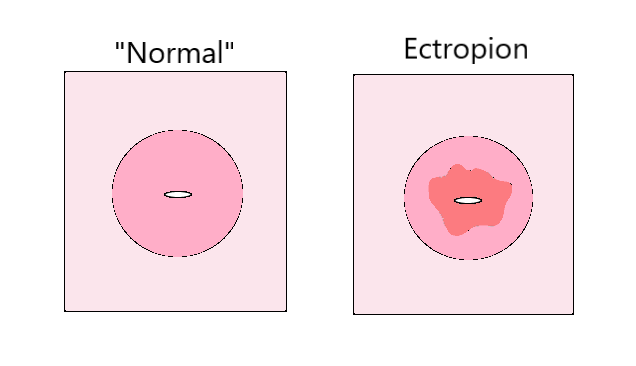
At the top of my audio-visual to-do list is an Anatomy 101 class. But until I get that recorded, I just want to share one variation OF NORMAL that I’ve encountered both doing medical exams and doing exams as a Bodeket Tahara. What I’ve found is that even when women have been sent repeatedly to a bodeket, they often aren’t told why they keep bleeding or what exactly is going on with their cervix (that the OB/GYN doesn’t seem to care about!).
Where is this happening?
(If these anatomical terms don’t pull up diagrams in your mind, don’t sweat it. We’ll get to that another day.)
The cervix is, more or less, the bottom section of the uterus – that pear shaped organ that holds pregnancies and sheds its lining for each period. The cervix sticks out into the vaginal canal. Many women are familiar with terms used to describe the cervix dilating and thinning in labor so a baby can pass through. But when the cervix isn’t being used as an escape hatch, it looks a lot like a pink donut (see the diagram above). That’s what your OB/GYN or your bodeket sees when he or she does a vaginal speculum exam.
So what exactly IS happening?
The outside of the cervix, or the “intra-vaginal portion,” is covered with a sturdy and elastic tissue that can handle bedikahs and sexual intercourse without being damaged. The inside of the cervix (through the donut hole :-)) is a different kind of tissue, one that has a large blood supply and produces a lot of mucus. In a “normal” cervix, the layers stay in their places, and women can do bedikahs without fear of causing bleeding on the surface of the cervix. On an ectropion cervix, the sensitive and blood-filled layer of the cervical canal is exposed within the (more acidic) vagina. This can cause bleeding that ranges from the tiniest spots of blood on a bedikah cloth to fairly heavy bleeding after intercourse.
What causes a Cervical Ectropion?
- Many women are just born with the internal layer flipped out (congenital)
- Pregnancy or birth
- Hormonal contraceptives with estrogen*
*Once a cervical ectropion is present, spermicides can worsen it because they make the environment in the vagina even more acidic.
Why does my bodeket describe this as a “petzah” but my OB/GYN doesn’t see anything wrong?
When your OB/GYN looks through the speculum, they see a Cervical Ectropion – a generally benign (not dangerous or problematic) version of “normal”. They do your Pap smears as recommended, being sure to catch a sample of cells from the “Transformation Zone” where the tissue types meet. Sometimes the cervix will bleed after a Pap, so they’ll apply a little pressure with a swab, warn you that you may see some spotting, and move on. Unless the Pap comes back with questionable results, chas v’shalom (most likely with smoking or certain local viral infections), or a woman complains of regular bleeding after intercourse, they really won’t give it another thought. Because, again, it’s medically normal.
What your bodeket sees is a spot that bleeds when rubbed (or sometimes just lightly touched) with a swab or bedikah cloth. She’s there to prove that the blood you’re seeing is coming from outside the uterus, not dam niddah. Because that “flipped out” layer produces a lot of mucus, on top of the normal discharge during the 7 clean days, a bodeket might even have to spend some time coaxing that potential petzah to bleed! Just as a woman can do days of bedikahs with no problem at all, see something problematic in the morning, and then get a clean bedikah in the afternoon.
What can I do about this?
First of all, if you have a Cervical Ectropion that doesn’t cause you problems, don’t think about it. Just keep doing your Pap smears and bedikahs as usual.
For some women, it is worth considering a switch in birth control methods (such as away from a high dose estrogen or regular use of spermicides). For those with a very clearly defined bleeding spot, cryotherapy or ablation can be done by your OB/GYN to stop specific blood vessels from bleeding. Some Cervical Ectropions caused by pregnancy and birth will just resolve over time. Speak to your Rav about how many bedikahs you should be doing with a known petzah, or bleeding spot, and how far into the vagina you need to be inserting a cloth.
*As with any topic I cover, further explanation and personal clarification are available with consultation. Basic questions and comments are welcome below.
 P'nima Wellness